

AI products incur real costs in real time, but most billing systems were built to record what happened. They can't control what happens next. As of Q1 2026, the gap between infrastructure costs and billing capabilities is one of the most common unit economics problems that AI companies discover too late. This article explains why billing and economic control are separate problems, and what it looks like when both are solved.
Traditional SaaS was predictable. Customers paid a monthly subscription, and whether they logged in once or a hundred times barely moved the infrastructure bill. Revenue was tied to seats. Usage rarely changed the economics in a meaningful way.
AI products operate very differently.
Every request consumes real resources. A single prompt to a large model, a multi-step agent task, an image generation: each has an immediate, variable cost determined by model size, token count, compute time, memory usage, and any third-party APIs involved.
The economics of AI products are dynamic. Most billing systems are not.
What's wrong with billing after usage?
Most billing systems operate on the same basic principle: usage is recorded during the billing cycle, and an invoice is generated at the end of the month.
For AI products, this model introduces compounding risk. If a customer suddenly generates massive workloads, the company absorbs the cost immediately. Billing happens later. By the time the invoice is created, the cost has already been incurred. There's nothing the billing system can do to prevent it.
This creates a specific set of problems that don't exist in traditional SaaS:
- Runaway usage from a single customer or a misbehaving agent can generate unexpected infrastructure spend with no automatic limit
- Margin visibility disappears between billing cycles. You know what something cost last month, not what it's costing right now
- Dynamic pricing becomes impossible to enforce when the billing system only looks backward
- The commercial pricing model gradually decouples from actual infrastructure costs as workloads evolve
Teams that cross into high-volume inference workloads typically discover these problems when they pull actual unit economics for the first time. Usage-based pricing that looked profitable at baseline turns out to have negative margins at scale for certain customer segments.
Why are billing and economic control different problems?
The core issue is that most companies treat billing and economic control as the same function. They're not.
Billing determines how money is collected. It answers questions like: what should be invoiced, what does the customer owe, when is payment due.
Economic control determines whether an action should occur at all. It answers questions that must be resolved before the action runs: does the customer have sufficient balance, what does this request cost, should it proceed or be throttled.
Billing happens after value flows. Economic control determines whether the value can flow at all.
AI products need both. Billing can still happen later. But the economic decision must happen in real time, before the model runs, before the tokens are generated, before the cost is incurred.
How does real-time economic control work?
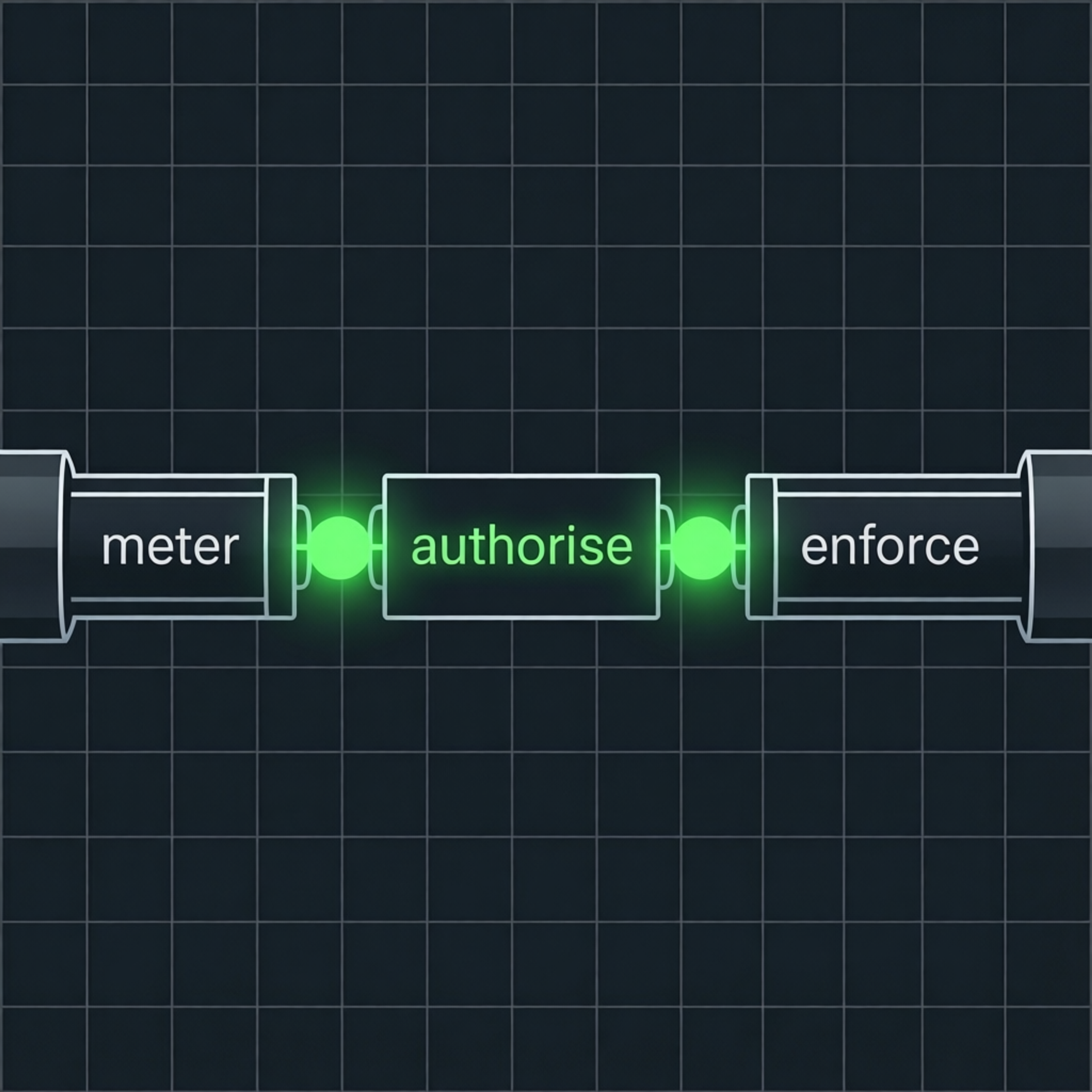
When economic control is embedded in the product runtime, every usage event passes through a decision layer before execution. That layer works in three stages:
- Meter: calculate what the action costs based on the request parameters
- Authorise: check the customer's wallet balance and plan limits to determine whether the action is permitted
- Enforce: execute and immediately debit, throttle, or block based on the authorisation result
The outcome of that evaluation determines whether the action proceeds. If sufficient balance exists, the action executes and the balance is debited. If limits are reached, the system can warn, throttle, or stop the request. Before the cost is incurred.
It's the difference between a billing system and an economic system. A billing system settles activity that already happened. An economic system participates in the decision about whether that activity should happen.
Here's what that looks like in practice. A user triggers a multi-step agent task. Before any model call is made, Credyt checks the wallet balance, estimates the cost of the task, and confirms the customer's plan permits it. The action is authorised and the balance is debited immediately. If the balance is insufficient, the task doesn't execute. No cost is incurred. No invoice dispute follows.
How do credits and wallets enforce economic control?
The most practical implementation of real-time economic control is a wallet with programmable credit balances. Instead of waiting for invoices, usage draws down from a balance that was funded in advance or included in a subscription plan.
Credits act as a programmable representation of value inside the product. They can come from:
- Included credits in a monthly or annual subscription
- Prepaid credit purchases by the customer
- Promotional allocations
- Enterprise budget pools allocated by team or project
By using balances as the funding source for usage, the system becomes proactive rather than reactive. Usage authorisation happens before the action runs. The wallet enforces spend limits automatically. No human needs to catch a runaway agent in a dashboard.
There's also a UX benefit that's easy to underestimate. Customers understand balances intuitively. They can see how much value remains and top up proactively. The billing relationship shifts from adversarial (dispute the overage charge after the fact) to collaborative (manage a balance in real time).
When is post-paid metering enough?
Real-time economic control matters most when workloads are expensive, dynamic, or autonomous. Not every usage-based product needs it immediately.
| Product type | Post-paid metering risk | Real-time control priority |
|---|---|---|
| Analytics queries, storage | Low; costs are predictable and small | Low |
| Low-cost APIs with stable pricing | Low to medium | Medium |
| LLM inference, image generation | High; costs are variable and immediate | High |
| Autonomous agents, multi-step workflows | Very high; costs compound without a kill switch | Critical |
As soon as workloads become expensive or involve autonomous execution, post-paid metering becomes structurally fragile. The billing system has no mechanism to limit exposure before it occurs.
How is billing infrastructure changing?
This shift mirrors what happened to payment infrastructure over the past decade. Early internet businesses used static payment gateways; transactions were recorded and settled. Modern payment infrastructure is programmable: it manages flows dynamically, enforces rules in real time, and participates in product logic rather than sitting outside it.
Monetisation infrastructure is undergoing the same transformation. Billing systems are evolving into economic systems. Instead of simply generating invoices at cycle end, they participate directly in how value moves through software, authorising usage before it occurs, enforcing margins in real time, and giving engineering and finance visibility that doesn't depend on a month-end reconciliation.
The practical implication: as AI-native products scale, pricing too conservatively limits growth. Pricing too loosely absorbs unexpected costs. Infrastructure that manages usage economics inside the product, not just records them, helps avoid both.
Closing principle
The systems that meter usage, manage balances, enforce policies, and determine pricing in real time are no longer optional infrastructure for AI companies. They're the economic layer that makes sustainable unit economics possible.
Credyt exists to provide that layer. Not just to bill for usage, but to control how value moves through modern software as it happens.
Building an AI product and running into these problems? See how Credyt works or get in touch to talk through your architecture.
For the practical adoption path, see how AI companies adopt real-time billing without replacing their stack, and for the category it defines, real-time monetization. For the broader category, see the AI billing landscape.